From Exposed Roots: A Collective Census of Culture

Showing posts with label racines en fleurs. Show all posts

Monday, February 23, 2015

Je n'arrête pas.

A year ago.
Tody Rodriguez- Villain
Photo credit: Gwen Aucoin


Les Mardi Gras vient de tout partout,
Tout à l’entour, l’entour du moyeu.
Ҫa passe une fois par an demander la charité.
Quand même si c’est une patate, une patate, et des gratons.

“WAKE UP MARDI GRAS!”

Les Mardi Gras sont sur un grand voyage
Tout à l’entour, l’entour du moyeu.
Ҫa passe une fois par an demander la charité.
Quand même si c’est une poule maigre et trois ou quatre coton maïs.

“I SAID WAKE UP MARDI GRAS!”

Capitaine, capitaine voyage ton flag,
Allons chez l’autre voisin demander la charité
Vous autres venir nous joindre,
Vous autres venir nous joindre quais au gumbo ce soir.

“BETTER HAVE YOUR MASK AND COSTUME ON WHEN YOU WALK OUTTA THAT TENT!”
_____________________________________________________

The roar of the villains voice outside was ensued by a thick twine rope smashing the frozen rain fly. The ice went crashing and splintered into millions of shards. It sounded like rain but it was hail. Packpackpackpleeen. It was cold- so cold. It was cold the night before, it was cold when you woke up, and it was cold the rest of that day. That wet Louisiana cold that pierces every layer and chills you down to the bone. I unzipped the tent, put on my boots, and looked around. People walked in from the front following a path that was worn into the earth. These people were dressed in costumes from head to foot. Lofty, pointed cone shaped hats- capuchons. Mocking traditional nobility, clergy, and educated. Masks to conceal your identity made of wire mesh with accoutrements. Dressed in patchwork and fringe. Role reversal is a common play. Women pose as men, the poor as rich, humans as beasts. Mockery and parody, mockery and parody.
My krewe woke up in a rush and hastily dressed. I did not clothe right away and the villains looked at me as they passed. Every time they did I ducked behind the tent to hide. I peeked and they saw me.

“YOU BETTER HURRY UP CAUSE WE’RE COMING THAT WAY NEXT!”

His whip cracked like a thousand lightning strikes and it birthed a weird sense of fear within my mind.

“I need a beer. A beer... hopefully they aren't all frozen.”

I found a beer and opened it, sounded just like that crack of that whip. It’s the Tuesday before Ash Wednesday- Mardi Gras. Six-thirty in the morning. The sun would have peered through if it wasn't for the overcast clouds. Five layers of wool and my costume went over it all. I tied my hat tight but left my mask off. I walked to the road and the villains threatened to whip me.

"GET THAT MASK ON OR YOUR GONNA GET THE WHIP!"

Their whip snapped into the wet pavement.
I looked at them, dead in the eye with my chin held straight-

"I'm your queen."
"SHE'S THE QUEEN, DON'T WHIP HER!"

Both of their voices coward away as they came to the realization that I am immune, sort of speak, to the power that they held. "They are the enforcers. They make sure we [the runners] keep our masks on and participate." The Villains are a symbol of authority- an authority that the Mardi Gras can, and should, rebel against. They can choose to rebel or they can choose to lay down. But royalty can guide them, Mardi Gras royalty has a certain power over the villains. They can send them to whip people, they can request items for consumption- however they cannot protect. A villain named Toby came to my place of rest and said for me to meet them when I was ready. When I arrived to meet my villain guards, they all took a knee in respect of my presence. 

"THIS IS YOUR QUEEN! SHE HAS IMMUNITY FROM YOUR WRATH! YOU ARE THERE TO PROTECT HER AND TEND TO HER WISHES AND DEMANDS...THAT ARE WITHIN REASON."

Toby turned his head to look at me as he says that last bit. I chuckled and accepted his words.

"My queen, what can I call you?"
"Queen Zozo!"

I heard from the troop of seven- all winding their way up from their knees

"AH! Zozo!"
 "How lovely and simple!"
 "Queen Zozo!"
 "My Queen Zozo!"

Immediately after, the villains got up and came to coddle my desires. 

"Bebé, do you need anything? Can I get you anything? Some whiskey, no?"
"No, I do not need anything at the moment."

The rain started trickling down in a drizzle and I began my walk to where the runners flocked. My pace left the sounds of the villain whips flogging the ground with the chants of the Mardi Gras song-

Les Mardi Gras vient de tout partout,
Tout à l’entour, l’entour du moyeu.
Ҫa passe une fois par an demander la charité.
Quand même si c’est une patate, une patate, et des gratons.

Les Mardi Gras sont sur un grand voyage
Tout à l’entour, l’entour du moyeu.
Ҫa passe une fois par an demander la charité.
Quand même si c’est une poule maigre et trois ou quatre coton maïs.

Capitaine, capitaine voyage ton flag,
Allons chez l’autre voisin demander la charité
Vous autres venir nous joindre,
Vous autres venir nous joindre quais au gumbo ce soir.

Villains' congregation before they set off.
Photo credit: Cameron Mehl 

Courir de Mardi Gras- the Louisiana country Mardi Gras; The Mardi Gras Run. A tradition that was brought to the rural prairies of Louisiana through the exiles of Acadie, the exodus of my people. But pre-dates European medieval times. The day before Ash Wednesday they went begging for ingredients to make a gumbo. A flag bearing capitaine lead a band of revelers, some on foot, some on horseback. They dressed in rags and fringe, and went neighbor to neighbor- house to house. They played music, they sang, they danced, and they begged. Begged for a chicken to be thrown, corn cobs to be had, or rice to be given. We still beg, two hundred years later and we still beg for chicken and rice. This tradition is made up of imitation. But jokery with intent. Many theories of the "truest" reason of the Mardi Gras exist, but none can be or have been deemed exclusive. The essence of this tradition has purpose, the very root of our culture evolves around community. The trip around the town commences a begging ritual not only to attain a gumbo ingredient stockpile but also to inquire about the health and well-being of the back road inhabitants.
L'hiver est d'enfer.
Il y'a fois jours et nuits.
Mardi Gras nous sauve. 
Growing up I had always been aware of this 'event' if you will. I knew that it was a thing to be celebrated. I remember going to class dressed in a fringed shirt with bells attached with a pointed hat and a mask to match. I remember asking my teacher if I could give my classmates beads and doubloons. I understood this was a 'thing', but I didn't understand the concept of my peers not knowing what the hell I was doing and why. Those kids gave me eyes, they all made faces and laughed at me for going to school in a courir de mardi gras costume. But it was what I knew. It was and continues to be apart of my identity, this tradition runs in my blood. Whether I knew it or not, I seemed to have always felt it.

My courir de mardi gras costume from 16 years ago.
A year ago, I experienced the Faquetaigue Courir de Mardi Gras, hosted by none other than Joel and Kelli-Jones Savoy out in Eunice, Louisiana. It was a notable year, I grabbed the first annual lundi gras royalty contest, remaining Queen of Faquetaigue until the next one is crowned. The run itself was iced. I witnessed literal ice cycles form in bearded men, fringes were frozen in place on costumes. I spent this year on the Church Point Courir de Mardi Gras along side some of my best guy friends. That particular run is enduring all unto itself. There is no denying the fact that this tradition, as with most folk communities, is patriarchal. And most of these traditional chickens runs have remained so over the years and will continue to uphold that status of being strictly all-male runs. Church Point is no different. Knowing this, I was still determined to complete it equal with the male counterparts. History is as stated by the Saddle Tramp Riders Club...
Elton Richard first formally organized the Church Point Courir de Mardi Gras in 1961. Until that point individual groups of men would ride horse back through the country on Mardi Gras Day begging for ingredients,or money with which to buy ingredients, for a communal gumbo. The first organized courir included approximately 400 horsemen. Elton Richard of Church Point and Senator Paul Tate of Mamou decided that each town needed its own courir and they flipped a coin to decide which town would have its courir on Fat Tuesday, Mardi Gras Day, or on the Sunday before Mardi Gras. Mardi Gras, the French term for Fat Tuesday, is held on the eve of the first day of Lent, Ash Wednesday. The results of the toss determined that Mamou would conduct its courir on Mardi Gras Day and the Church Point courir would take place on the Sunday before Mardi Gras.
On Louisiana's Cajun Prairie northwest of Lafayette, the annual celebration before the beginning of Lent takes on a completely different form. The first Acadians brought "Le Courir de Mardi Gras" or the "Running of the Mardi Gras" to French Louisiana when they immigrated to the area in the 1750's. The custom of European peasants merrymaking before a period of fasting and penitence was handed to them from medieval times and was practiced by the Romans before then.
Traditionally, the rural Mardi Gras of today in Church Point is the same as it was in the old days of the early settlers. Men only can participate in the Courir (run). Tradition requires that all Mardi Gras be fully masked and costumed.
Le Capitaine (The Captain) heads the group and he and his co-capitaines must ride unmasked. The first Capitaine was the founder of the Church Point Mardi Gras. The Capitaine is allowed to retain his title year after year until he chooses to relinquish it and then hands it down to the man of his choice. Each year the Capitaine appoints his co-capitains for the run that year.
The morning started out rough, a cup of coffee and a link of boudin. 7 o'clock we head out to Church Point. Park, walk, walk, arrive. Trailers upon trailers of masked revelers, dozens of hooved legs waiting in line. Bowing heads, reins being tossed. I hear all of the horse bits being masticated. The participants looked at us as if we are some sort of foreigner in a territory that belongs to a particular people. For which we essentially were. This male dominated scene posed a threat to my senses, almost fear inducing. My stance striked an assured form. My back straightened with a slightly rounded shoulder, my hips moved inward, my legs held a proportionally balanced weight. I didn't dare throw a hip or purse a lip for fear of undoubted humiliation. It's funny now that I look back at that moment, I should have accepted the fact that I was obviously not welcomed. But that lone reason, that singular moment pushed my want further. I was setting off on a conquest. Because I knew, I knew the rules and regulations of this run. I knew what I was getting myself into and what could consequently happen if I disobeyed. Louisiana French women are traditionally identified with the ideal values of home, family, childrearing and order. Women are cross-culturally associated with passivity and submissiveness, compliance and obedience. Women traditionally play supportive parts which are more or less extensions of their domestic roles: they sew the Mardi Gras costumes, cook the gumbo served at the end of the run, applaud and dance with the maskers. They revel on the side, overlooking the aggression, rowdiness, and antics that that day of parody play elicits. They skirt around wearing gardes soleils and aprons with a needle and thread in their pocket to sew up any little tear that may happen. Mardi Gras runs have frequently been described in terms of male values and competences, as an initiation rite which defines manhood and a celebration of cowboy machismo. But with this tradition of role-reversal, where lies the intended subliminal statement of female empowerment? These contrasting values are intertwined in barbed wire and have been challenged since the break of WWII. Carolyn E. Ware writes
At least one oral account offers a description of women running Mardi Gras near Soileau during the early decades of the twentieth century (Courville 1992), but female Mardi Gras are primarily characteristic of the decades following World War II. During the 1950s, 1960s, and 1970s, women formed "ladies' runs" in at least six (and probably more) prairie Cajun communities. 
A woman Mardi Gras. Photo: Carolyn Ware.
The women Mardi Gras visit a house. Photo: Carolyn Ware.

It seemed instantaneous, from the point of arrival to when the Capitaine raised his flag and whipped it around and around. He chanted "ALLONS MARDI GRAS!" Shrieks and yells, and screams were emitted from the masqueraders. After the horses flooded the streets following the runners, I cloaked my facade and I left in a trotting state in pursue of a familiar silhouette. I galloped to find the trailer that hosted someone I knew. Nothing except a bottle of Irish Whiskey in hand, my costumed body and masked face to protect me. A backdrop of dimmed sunlight exposed by overcast clouds encompassed the already sweat dewed faces of the costumed runners. The faces became visible the closer I got to them. I found a krewe. Was it the krewe that included me? It wasn't, in all reality, because as many people as you may know en route, you will always be alone and on your own. Masked and costumed with fringes up to your neck, preserved anonymity is performed at its best. But I was able to find unmasked faces that resembles my friends. I offered them the remains of my Cajun coffee that got me started in a harsh manner. I was recognized by my guise, entire black with silver undertones with a plague doctor beak and a pirated hat, but applauded by my effort of disguise. I knew I was unwelcomed on the trailer itself, so I walked along the side. But walking did not allow an in time stride so I began a jogged pace. That was the only way to stay equal with my counterparts. Once the guys figured out I was female, they made me work to be able stay in the Mardi Gras. However, the Capitaines didn't take lightly to my presence. I tempted to invade, sort of speak, the trailer. I did manage to step foot and remain planted for a few minutes while I exchanged tongues. Then, a roar stilled my motions and discomposed my mind.

"I'm not going to be nice! 
Get your beak and get the fuck off my Mardi Gras!" 

I assumed he was talking to me, the one who was wearing fringed leggings and silver tipped cowboy boots that obviously accentuated my back and bosom. I crissed my legs and swung ever so slightly with bent knees. He points to the stairs. My inebriated mind wanted to throw a défi. Une challenge. A challenge, to challenge that Capitaine that dare question my ability to stand with these men. But instead, I composed my psyche, curtsied and bowed my head, and walked to the end. I shoved past a pack of beasts, throwing elbows and shoulders to get through. I yelled at the Mardi Gras that stood complacently on the stairs.

"ALLEZ-Y MARDI GRAS! MOVE MARDI GRAS!"

Photo: Sarah Zaunbrecher
I jumped from the moving trailer onto the street, only to be gazed upon by the masked horse riders. Did I care that I was identified? No, because me being the stubborn bull I am, was not about to give up at the laughter of these boys. I continued trekking but was stopped by a shoulder grab of a hard-hatted man. He wasn't in costume, nor was he masked in any way. But by the tone of his voice, I knew exactly who it was. Monsieur Blake Thibodeaux, of Church Point. A friend of whom I've known in passing for the past year. He lifted my hat to slightly reveal my face. He had such a worried look on his face. He asked me "Are you okay? Do you know why they kicked you off? I told you to keep your hat on and to stay low." I interrupted his inquiries, "I understand the risks and consequences that come along with attempting to participate in this run as a female. I'm fine." He smiled and compared me to Rosa Parks, the one who defiantly remained sitting in a particular buss seat when the law told her to do otherwise. But strict laws pertaining to the uninvited females on these courirs are continued to be upheld every year.
"Popular author Harnett Kane, in his 1943 book The Bayous of Louisiana, wrote that the country Mardi Gras run is 'primarily for men and horses.' Its begging, singing, and riotous horseplay, he commented, 'has no place for the girls . . . although there is a happy fais-do-do [dance] in the evening.'" -Carolyn E. Ware  
The Cajun community has historically been a very closed Catholic society, particularly, in which girls did not have a great deal of behavioral leeway. Looking at the lyrical context of Cajun French songs, more often than not, they depict females in relation to their male correspondent. Being referred to as "unconventional" or "unavailable", girls are a melodic source of unhappiness, heartbreak, and are nevertheless a dangerous and a potential cause of misery to men. Cajun women evidently understood their domestic part; so don't get me wrong, many women enjoyed their supportive roles and accepted the fact that only men ran Mardi Gras and clearly grasped the "It wasn't a custom that we [girls] did run" concept. But eventually, though—maybe inevitably—some women decided that they too wanted to mask and run Mardi Gras. As possibly some have put it before-


Yes, females may be pretty, little, and fickle. Characterized as meek, frail, maybe even porcelain like. But such generalizations don't come without exception.
"Other women, though, are a match for any male Mardi Gras in their roughhousing. Some have said proudly, 'We're the chicken chasers . . .  [always] in the mud and the barbed wire.'"  -Carolyn E. Ware 
The challenging of superior authority is not a Joan of Arc seizure of power. I am not here to change the tradition. I masked as a rebellious figure to recount the maintenance of the tradition.
This is how I, along with a few others, participate in the preservation of our culture. The endeavor of objection. Mardi Gras, a day to revel and parade in masquerade and costumed bodies. A day to ride the play of beasts' antics, whom one is truly not. So why should I stand on the side and simply view a demonstration of 200 plus men make a trek of cultural importance on a day that evokes character transposition? That's not even a question for me to barter with.
A sixteen mile trail on foot,
a fifth of whiskey,
and a hanker of a thousand desires.

 J'ai challengé et je y'ai fini. 
Mais, je n'arrête pas. 
Merci.
   
Photo: Paul Kieu

Friday, August 1, 2014

Une Lettre d'une Amie

1.30.2014
Composed by Kelli Landry
Lafayette, Louisiana
by way of
Pierre Part, Louisiana
_________________________________________________________________________________


Waking up to the sunlight. There’s something so human about waking with the birds. Free from man made devices; alarms that our bodies reject with our hands stamping down on it. But the morning sunlight. It’s gentle, subtle, loving, like my Ma when she used to softly shake me from my dreams when I was a child.

It’s early. Probably 8:30AM. I’m looking forward to this morning. We are fully equipped. Eggs, bacon, coffee, music. Waking up to a Freetown morning, there is a special anticipation.

My two friends, the lovely Zoë and Katie, live in what I call “the camp.” Wooden walls, wooden floors, 2 bedrooms, 1 bath, 3 cats, no wi-fi, no dishwasher, no TV, and a gas stove. We crawl out of our cocoons that we wrapped ourselves in from the night before. Zoë turns on the stove to heat the kettle. First things first for a Cajun girl. Coffee. Brewed in the French press. We wait. And wait. The kettle overflows.

“Shit.”
Zoë sees that it overflows. Grabs it off the stove, pours the coffee into the press. There’s something holy about fresh caffeine. Not even that it warms you or wakes you up. But sitting down with my friends, and soaking up every drop of peace.

We go to the kitchen, and both sinks are filled with dishes. I volunteer to wash, while Katie and Zo prepare for our morning meal.

“Old school or new school?” Zo asks both of us.

“Definitely old school.” Katie says. We all agree.
We wash dishes. The bacon fries. Egg shells are cracked. The cast iron heats up. Cleoma Breaux, D.L. Menard, Amede Ardoin, Iry Lejeune, The Balfa Brothers sing from Zo’s computer. Our old school.

There is silence amongst all of us. And this is where I can’t help but fall in love.

There was something about washing the dishes, hearing the tinkering in the kitchen, smelling the bacon fry, tasting the coffee, and hearing the cries of a Cajun people sing about love, heartbreak, the 2-step, front porches, ... listening to the fiddle, accordion, and guitar among others come together in friendship.

Every once in a while I’d look back, and take it all in. Seeing us not just as three women cooking breakfast together, but loving every step of the process, even in the little silence of the morning. There was no need for conversation at that moment. Just listening to the songs of our true home. What brings about a simpler time. With shotgun houses that were filled with what was necessary, with a meal made and shared among friends, with music that wasn’t made for money, but for the love of an existence that remains today still very much alive.
We sit down at the round table, with no reservations. Three friends sitting down as a family around a table with no edges. No one excluded, and I’m thinking about the Acadians. They hiked to the ends of the earth to be reunited with their relatives who were lost after the exile. What a passion to search for family of which we don’t choose, from who we are born crying into this world hoping to feel like we belong.

I’ve never felt more at home sitting down in this small spot in the world. Louisiana. Lafayette. Freetown. The camp. A round table. With people who I consider my family. Who, if ever separated, I would crawl through the soil to find again just so I can sit with them in silence during a gloomy morning listening to a Cajun song with our only concern of living unapologetically.

Thursday, July 24, 2014

The Divine Emulation


divine  (dɪˈvaɪn) 
adjective
1. of supreme excellence or worth
_________________________________________________________________________________

em·u·la·tion  [em-yuh-ley-shuhn]
noun
1. effort or desire to equal or excel others

When we look at culture, it changes and evolves. One generation to the next- like language, like music. It can go left or it can go right. One thing that I have gathered through casual conversation within this culture is the importance of inspiration. Influence among these musicians vary from the pre-accordion era in the 1900's and before to the Cajun swing of the 1930's. From the 1970 Cajun renaissance with the traditional sounds of the Balfa Brothers to the 1980's and 90's zydeco rock of Wayne Toups and even the modern fiddle's cadence of Al Berard and Mitch Reed. I find it intriguing to know what drives an individual musical mind because we all think differently, we all learn differently- we all taste differently. The prairie Cajuns of Mamou, Iota, Church Point, Pointe Noir, and Opelousas have historically been in a contrasting external environment from the swamp, bayou, and marsh Cajuns of Breaux Bridge, Cecilia, Henderson, Butte la Rose, Chenier au Tigre and Pecan Island. The difference in what they have been given exposure to is immanent. Dewey Balfa once said "A culture is preserved, one generation at a time." And a look into the minds of the cultural intuitive, generation by generation, reveals how we are holding onto our culture from the tunes of our ancestral-folk roots.

This is an ongoing project of personal interest, the research and collection of a cultural census of influence. My initial want was to include multiple generations to get a look into those influences and how it's generational, de les vieux à les jeunes. How the music progresses but yet how, simultaneously, the musical history, tradition, and meaning is retained.


From the Exposed Roots presents The Divine Emulation, a collective cultural census on personal influence.

Tuesday, July 8, 2014

Pour Chere Josephine

For Josephine-
She'll get it one day...

"She looks up at me
With clear blue eyes
Expecting an answer
For all her whys

Her hand rest in mine
Safe, secure, without doubt
The other held in habit
Fingers folded, thumb in mouth

I collect her tears
And share her sorrow
Guide her today
While planning tomorrow

What of tomorrow?
What is left?
What do I tell her
Of it's theft?"
___________________________________________________________________________________


"She knows nothing of
Our days of glory
The flight of yesterday
Is but a bedtime story

As a forgotten fable
I tell her of a day
A day long gone
But not so far away"


"It is not a tale
Of fairies and elves
From worn out poets
On dusty shelves"


"It is the story of us
Our people, this land
When existed a balance
Between nature and man"


"A time before industry
Swallowed it all
Prior to our parents
Taking the fall"


"Before interstates
And inter web travel
When the mysteries of youth
Would slowly unravel"


"Before greasy handed tycoons
Stole all of our shores
And pop corn politicians
Became two dollar whores"


"Before convenience became king
Making comfort his queen
And a fellow man's struggle
Goes sight unseen

It is way before our phones
Would make us all dumb
And networks for socializing
Turns neighborhoods numb

Before television and oil spills
Polluted these lands
And making fun of my accent
Meant the back of my hand"


"The day before language
Was beaten and taken
Ripped from a culture
Already forsaken

I say to her
Let us talk about a day
A day long gone
But not so far away"


"A day when children
Ran barefoot in the field
And help their parents
Harvests its daily yield"


"When good clothes were reserved
For Sunday at best
And a cousins hand-me-downs
Meant more, not less"


"No digital games
Or online friends
Just a bike, a brother
And a day with no end"


"We were pirates and poets
Artist and thieves
Drunk in our imagination
With dreams to believe"


"We picked our own eggs
And milked our own cows
While Moma's and Daddy's 
Stayed true to their vows"


"There were fences to build
And pastures to bail
Ya Moma could slap you
And not go to jail"


"Fathers were feared
But took care of their own
And dogs were fed
What was left on the bone"


"Chickens were plucked
Hogs were scraped
And no one cared
If it was filmed or taped"


"A grandmother's table
Was always full of food
And she'd slap you also
If she was in the mood"


"Our sugar was our own
Milled in Breaux Bridge and Cade
Before Uncle Sam cut cane
And called it free trade"


"All rice came from Crowley
Not overseas
Served with basin crawfish
Not Chinese"


"We drank coffee
And called it a visit
Talked about life
Not what was posted"


"Long summer walks
Through thought and time
Without digital pollution
To clutter the mind

We never missed a meal
Our bellies were full
We slept like rocks
And worked like mules

Everything we wanted or needed
It came from this land
But now... today
It's all from a can"


"It was basic needs
For simple times
When a slower pace
Created complex minds

She ask me 'Daddy-
Where is this day?
And if we go,
Can we just stay?'"


"'Beb, yesterday is lost
And today is decided
Though tomorrow is a choice
And you have been invited'"


"In her eyes I see hope
So clear and true
Just because we're lost
Doesn't mean we're through

So I tell her that this time
Might be another day
A day that is long gone
But not so far away"
_____________________________________________

-Words so delicately composed by Toby Rodriguez,
 for his sweet Josephine, daughter, five years of age-
___________________________________________________________________________________

Grand Coteau, Louisiana 
by way of
Breaux Bridge, Louisiana
7.8.2014

Friday, May 16, 2014

Louisiana Focus on KRVS

Louisiana Focus on KRVS 88.7 talked about the use of the French language in work places here in Louisiana. 

Tuesday, February 18, 2014

Arc Attente


Horse hairs strung from the tip to the frog. Turn the screw to the left- it loosens. Turn the screw to the right- it tightens. The tension created by a simple pivot of the silver screw bows the wooden stick straight, straight with a little arch inward towards those horse hairs. Now hold it. A bow hold- your bow hold. They say the fiddle is one of the hardest instruments to master. There are no frets, there are no buttons- no definite answers to the notes you want to play. I always find it interesting looking at the music maker and their art, the relationship with their instrument. How their hands hold and caress their love to make such beautiful sounds, make beautiful music. A fascination between the hands and ears. It's how your drums transposes what is being played by the arms and fingers- vice versa. Trills and thrills, graces and traces- all interact with the melody to shape the song, truthfully. Each fiddler is unique in their own right, simply because of style. 
Dennis McGee, born January 26, 1893, is a class all unto himself. Himself- that's all. A la bal de maison he played. He played fiddle for the dancers, not only waltz' and two-steps, but he played one-steps, polkas, mazurkas, reels, cotillions, and varsoviennes. Old school traditional. Fiddle tunes- fiddle music. And that's what Cajun music was before the 1920's, before the influence of the accordion. The introduction of the bellowed instrument greatly simplified, the now, fiddle part. Not fiddle tunes anymore. There was no need to be intricate, no need to fill the spaces and gaps of silence with drones and notes of the fiddle strings to the extent that was before. The way Dennis McGee played, some would say sloppy, but above all else is something that is not heard of today- modern day. It captures the movement and the evolution, from what once was. He played with Amede Ardoin, Sady Courville and Ernest Fruge, he knew the greatest and was one of the greatest. 96 in 1989, he left. He left behind a legacy that will always stay, it will always be read, it will always be heard, it will always be played and appreciated. 
Over the weekend I was given an album, an album of just Dennis Mcgee- 
Dennis McGee: Himself 
Produced by Valcour Records. It's a series of excerpts from a recording done by Monsieur Gerard Dole using a "Nagra III and a Beyer M 69 N Dynamic microphone in Eunice on Wednesday the twenty-seventh August of 1975." Thirty-three tracks some just a mere twenty-five seconds short, but of such "clarity and energy, in his specific old-time Cajun style..." Sunday morning I scratched at the plastic covering until it gave way, it tore and split to reveal the cardboard case that held the CD. This particular recording of Dennis McGee stayed unpublished until Joel Savoy mastered, produced, and set it free in 2010. I laid it down on my faded denim blue trunk that serves as the coffee table. Picked up my mug and took a sip, my fingers slid under the top of the cover and flattened it out. Took the disc and put it in the stereo, it played. He speaks, he plays, he sings. Nothing but Dennis McGee. I sit back and listen, I listen. I close my eyes, I cross my legs, I sip my black coffee. Mon coeur- my heart aches with love. I can hear him and where his fingers press and what his arm bows. It's clear and prevalent. It's exactly what I need to progress my own style, my own style of playing. 


Merci beaucoup Dennis McGee.

Sunday, February 2, 2014


1.25.14
Maurice, LA

Billy McDonald
Jonathan Melançon
Jourdan Thibodeaux
Blake Thibodeaux
Jamie Lynn Fontenot
Justin Léger
Alan LaFleur
Samuel Giarrusso
Noelle Goodin

Defrosted ground- saturated. Soft and sodden soil. It engulfed your boots with every step, encompassed the sides with mud, grass, et crotte de cheval. Not good for suede cowboy boots. The dark consumed the evening but the slightest bit was illuminated because of the stars, the stars and flames. Even without eyes you could find your way through the pasture. The sounds. A step forward toward the music- accordion, twin fiddle, guitars, 'tit fer. The yells, the bellows, the cries.


Tuesday, January 14, 2014

Attaché au Sol Natal


"Très sédentaire parce que physiquement attaché au sol natal." 


They say we come from stubborn, agricultural stock. Hard-headed and gruff. I've come to learn that my hand is calloused and my pith is rigid. My hips are thick and my feet are set. But they have to be, they had to be. The past has sentenced my way of living to manifest into what it is now. The endeavor of the Acadians is akin to the air I've breathed. The great upheaval of my common people, the estrangement of my brio from a soil I am meant to till. It is taught to these folk the history of their people, the reason why this culture exists. It’s a form of common knowledge- something I never acquired, a history I never knew. My life was lived unconsciously for nearly two decades before my mind provoked a self-awakening.

Upheaval, lifting or rising, forcing or throwing up, the root of major fray.

When my crown broke out, I was crying, wailing at the brim of my lungs because it hurt. It hurt to see the light, it hurt to feel the cold, it hurt to breathe the air. It hurt. To be taken from a place of such comfort and thrown into a state of uncertainty is eerie. There is no guide, no direction. No sure way to find the end. Wandering swallows any being that dare fall in, altering an ego into a wanderer. 1755 to 1762 was the course of the exodus. The Exile of the Acadians from Nova Scotia. The deportation of an entire culture because they refused to submit, they refused to take an oath of allegiance to the British government. The refusal to take that oath over many decades ended with Le Grand Dérangement. The cardinal of the expulsions began in 1755; it’s when Acadian homesteads were set ablaze, it’s when Acadian people were chained, it’s when the Acadian life was deprived of their livelihood. Ritual scalpings were done to captives, a blade running down the contour, tearing and ripping and spilling that vermilion blood. Bloodcurdling screams intertwined in the haze of the grey fog and the haze of the reddened earth. I can hear the children bellowing air from their lungs. I can see flames breach the heat weakened roofs. I can feel the torment that entices the rage. The history that I have come to know has given me an intimate relationship with the understanding of who I am, because of my predecessors. The pain of being raped of your identity, of your land, of your home, of your friends and family- I know all too well. The roots I set into the soil of Louisiana the day my mother separated my soul from her womb had been severed and ripped. Transplanted to a land so foreign to the south, into States that freeze, my roots froze. They tried to grow; they tried to heal, but that they did not do. The ones deported forcefully to an unfamiliar loam will never be satisfied, they never were. The thirteen colonies proved infertile for the alienated Acadians. Few were tolerated but most were detained, detained and malnourished. Imprisoned and impoverished, disease and starvation stricken- the Acadians are survivors. They were severed, they were ripped and cut. Taken from family, taken from land that they had come to know, come to love.
On July 11, 1764, the British government agreed to legally allow Acadians to return to their homeland. Many did, many went back. But they went back to nothing. An empty memory, just a façade of what once was. Their land was given away, their houses burned, their livestock slaughtered. Nothing was spared. Feet firm on the ground with only the hands of family and culture held- they wandered. I wandered with them.

Wandering- roaming or rambling, having no permanent residence, meandering or winding.


The Period of Wandering, a course of seventeen years in the history of the Acadians, derived the unforeseen settlement of Louisiana. It’s fathomable, completely. The Halifax band assumed a voyage from Nova Scotia to St. Domingue, it deviated into a route for Quebec through the Port of Orleans because of the words of maltreatment of French immigrants by authority. But they never made it to their desired destination. The bankrupt Spanish colony couldn’t offer any monetary support to the refugees once they made it to New Orleans, but instead offered permanent settlement. Into the wetlands and into the prairies they went. The Acadian sprawl along Bayou Teche was christened New Acadia, the place they've been looking for. A place so fertile with life, this is where they could continue their legacy. Be it with the waterways, the grand prairies, pine forests, or the marshes and swamps, they made this place their home. They brought with them their morals, language, music, culture and heritage and created the Cadien- Cajun. Je suis cadien. The tiny shards of my roots that managed to stay grounded stretched every time we made the voyage to this land. They grew with every visit, with every conversation, with every story told. My Louisiana rhizomes continued to grow and flourish underground while the roots I tried to plant elsewhere did not, they never bloomed. It wasn't until that self-awakening that I decided to unearth my longed for bedrock. I came back, I made it back. I found it. Under all that dirt, all that dirt and grime I found the rootstock that is mine, the rootstock that I am supposed to grow.  Natural soil, sol natal. To be attached to such again is breath taking, my vermilion blood is slowly making its way down to the core, down the course the roots paved hollow. The further down it flows, the higher the bud grows. Roots in bloom they are, roots in bloom they will be. Racines en fleurs. 

Wednesday, December 25, 2013

Pulet de Noël


Pulet de Noël
À l'élevage du poulet, à le regarder grandir,
Louons la vie il a vécu. Nous avons pris, nous a tué.
Le poulet va dans le gumbo pour le souper.
12.23.13
Breaux Bridge

We get into the truck, turn on the radio. KBON- the whole ride thru. Down the Breaux Bridge Highway onto Bridge Street Highway, keep going. A little past Catin's Grocery and Hardware Store. We're here. The night is old and it's cold. Louisiana cold. That wet, piercing chill. My pop puts the truck in park and flicks the radio off. The doors open with a creaaaek and are quickly slammed shut. "Aye, Country! We cuttin' some roosta's or what?" The wind whips at your cheeks and nips your nose. "Mais, yeah! That's why you came here!" My Uncle Ben suits up in his thick-lined jumpsuit in the middle of the carport. The illumination of the propane flames burning under the steal pot and the light from the porch back lit my uncle. A short, stout shadow stands. He's ready. My pop walks over the gravel and balances his weight on the two inch shoulder of the cemented land for a moment. He continues his stride- to the center table. He places a pair of leather work gloves and a knife down.
We're all ready.
Waiting.
Then I follow, follow the boys. My uncle, my pop, and my brother. Stepping down onto the crisp grass, we rustle through the fallen leaves to a shed on the edge of Nonc Ben's land. He opens the rusted tin doors just enough so he can comply within the slot. He jumps over his four-wheeler and reaches at the top shelf, grabs something and emerges through those rusted tin doors. His right hand grips an ax. That ax was Granpaw's ax. Granpaw Bennet Tally. "You'd see it around his camp and even in Cow Island," my pop remembers.
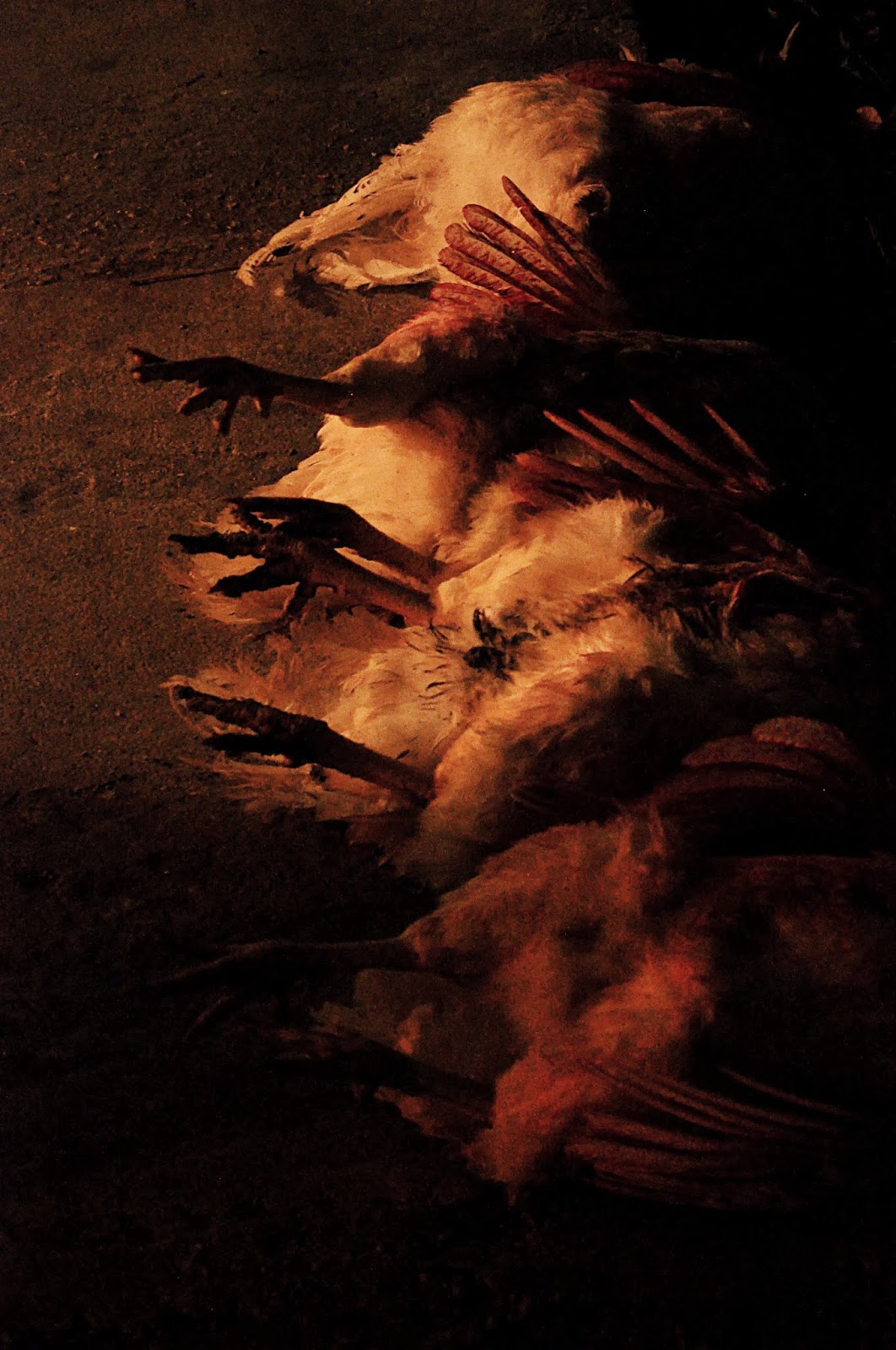
Again we rustle through the leaves and grass, walking a trail that is worn into the earth. To the coop- the chicken coop. Nonc Ben bends his knees and hunches over, "close the door behind me." He goes in. The hens voiced a few words. No resistance, no retaliation. Just acceptance. The swift movement of his arm seized the legs of the first rooster. It hangs, wings sprawled- just looking. "Here." My pop steps in and the bird is exchanged. Still hanging, wings still sprawled- still just looking. Again, another one taken. Two down, two to go. We walk to the other coop where the remaining roosters perch. This time the roosters sing, they croak and crow. All four are now hanging by our hands. Just waiting. The crisp grass crunches beneath my boots and the crinkled leaves part with every step forward I make. That walk seemed like an eternity. The wind lashes out and pierces my jacket down to the skin. Frissons. We stop next to a towering pine tree. A nail marks the spot, "hold it still." My pop's fingers intertwines with the legs and toes of the rooster- Nonc Ben stretches the neck and holds the head down against the bark with his left hand while his right grips Granpaw's ax and retracts it parallel to his ear. "I'd hate to miss." At that moment I blessed the creature and paid my respects. It's pertinent to know where your food comes from and to be grateful and thankful to the soul that is ceasing to exist to serve your very essence. A force drives the ax down, like a lion preying for meat. Down it goes, "Awwgh!" It didn't cut all the way through. A faint squawk is vocalized. Tout de suite, it starts flapping it's wings trying to fly away, to get away. Faster and faster it goes. Trying so hard, trying so hard to leave-to escape for haven. But it's just muscle memory. No longer can it think, no longer can it feel, no longer can it live. As it flaps the blood flows, down from the pith, down from the toes. It bleeds that vermilion blood. That blood of my people. Its motion slows, slower and slower... Ce fin.
We make our way to the cemented land, to the edge. Laid down are the four lifeless fowls, side by side. Those toes stick straight out and the wings too as if they were broken. Deep red caress those once white feathers.
The flames blaze under the steal pot causing the water to roar. The smell, get ready. Oh yai, that smell. "It's something you can't forget." Nonc Ben picks the rooster up and raises it high. It hovers above the scalding water, down it goes. Fully submerged just for a second. Just as quick as it went in, it came right out. It hangs, dripping water. The water drips over the pot, over the pot, over the cement, over the trashcan. It hangs over the trashcan. Nonc kneels and my pop squats. They start plucking. Feather after feather, they fall into the can underneath. The rooster is neked, completely bare. Skins.
Done.
Next one.
Next one.
Next one.
Done.