From Exposed Roots: A Collective Census of Culture

Tuesday, March 11, 2014

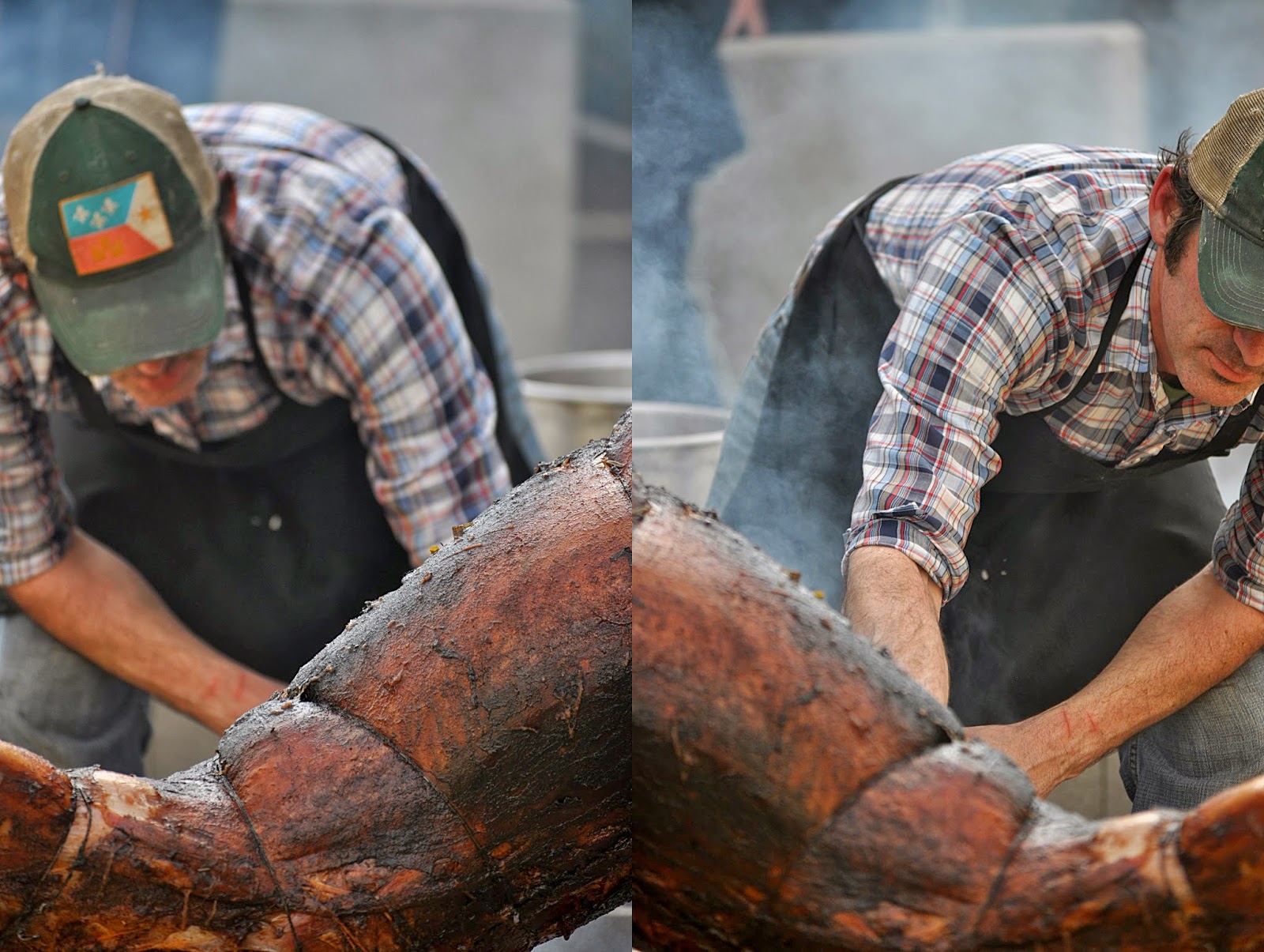
Agneau


 "You have to cher-cher da' meat"
___________________________________________________________________________________

"You like dat', huh? It's a little love tap."
while basting the lamb

-Mr. Toby Rodriguez
Boucherie Master

Tuesday, February 18, 2014

Arc Attente


Horse hairs strung from the tip to the frog. Turn the screw to the left- it loosens. Turn the screw to the right- it tightens. The tension created by a simple pivot of the silver screw bows the wooden stick straight, straight with a little arch inward towards those horse hairs. Now hold it. A bow hold- your bow hold. They say the fiddle is one of the hardest instruments to master. There are no frets, there are no buttons- no definite answers to the notes you want to play. I always find it interesting looking at the music maker and their art, the relationship with their instrument. How their hands hold and caress their love to make such beautiful sounds, make beautiful music. A fascination between the hands and ears. It's how your drums transposes what is being played by the arms and fingers- vice versa. Trills and thrills, graces and traces- all interact with the melody to shape the song, truthfully. Each fiddler is unique in their own right, simply because of style. 
Dennis McGee, born January 26, 1893, is a class all unto himself. Himself- that's all. A la bal de maison he played. He played fiddle for the dancers, not only waltz' and two-steps, but he played one-steps, polkas, mazurkas, reels, cotillions, and varsoviennes. Old school traditional. Fiddle tunes- fiddle music. And that's what Cajun music was before the 1920's, before the influence of the accordion. The introduction of the bellowed instrument greatly simplified, the now, fiddle part. Not fiddle tunes anymore. There was no need to be intricate, no need to fill the spaces and gaps of silence with drones and notes of the fiddle strings to the extent that was before. The way Dennis McGee played, some would say sloppy, but above all else is something that is not heard of today- modern day. It captures the movement and the evolution, from what once was. He played with Amede Ardoin, Sady Courville and Ernest Fruge, he knew the greatest and was one of the greatest. 96 in 1989, he left. He left behind a legacy that will always stay, it will always be read, it will always be heard, it will always be played and appreciated. 
Over the weekend I was given an album, an album of just Dennis Mcgee- 
Dennis McGee: Himself 
Produced by Valcour Records. It's a series of excerpts from a recording done by Monsieur Gerard Dole using a "Nagra III and a Beyer M 69 N Dynamic microphone in Eunice on Wednesday the twenty-seventh August of 1975." Thirty-three tracks some just a mere twenty-five seconds short, but of such "clarity and energy, in his specific old-time Cajun style..." Sunday morning I scratched at the plastic covering until it gave way, it tore and split to reveal the cardboard case that held the CD. This particular recording of Dennis McGee stayed unpublished until Joel Savoy mastered, produced, and set it free in 2010. I laid it down on my faded denim blue trunk that serves as the coffee table. Picked up my mug and took a sip, my fingers slid under the top of the cover and flattened it out. Took the disc and put it in the stereo, it played. He speaks, he plays, he sings. Nothing but Dennis McGee. I sit back and listen, I listen. I close my eyes, I cross my legs, I sip my black coffee. Mon coeur- my heart aches with love. I can hear him and where his fingers press and what his arm bows. It's clear and prevalent. It's exactly what I need to progress my own style, my own style of playing. 


Merci beaucoup Dennis McGee.

Sunday, February 2, 2014


1.25.14
Maurice, LA

Billy McDonald
Jonathan Melançon
Jourdan Thibodeaux
Blake Thibodeaux
Jamie Lynn Fontenot
Justin Léger
Alan LaFleur
Samuel Giarrusso
Noelle Goodin

Defrosted ground- saturated. Soft and sodden soil. It engulfed your boots with every step, encompassed the sides with mud, grass, et crotte de cheval. Not good for suede cowboy boots. The dark consumed the evening but the slightest bit was illuminated because of the stars, the stars and flames. Even without eyes you could find your way through the pasture. The sounds. A step forward toward the music- accordion, twin fiddle, guitars, 'tit fer. The yells, the bellows, the cries.


Tuesday, January 14, 2014

Attaché au Sol Natal


"Très sédentaire parce que physiquement attaché au sol natal." 


They say we come from stubborn, agricultural stock. Hard-headed and gruff. I've come to learn that my hand is calloused and my pith is rigid. My hips are thick and my feet are set. But they have to be, they had to be. The past has sentenced my way of living to manifest into what it is now. The endeavor of the Acadians is akin to the air I've breathed. The great upheaval of my common people, the estrangement of my brio from a soil I am meant to till. It is taught to these folk the history of their people, the reason why this culture exists. It’s a form of common knowledge- something I never acquired, a history I never knew. My life was lived unconsciously for nearly two decades before my mind provoked a self-awakening.

Upheaval, lifting or rising, forcing or throwing up, the root of major fray.

When my crown broke out, I was crying, wailing at the brim of my lungs because it hurt. It hurt to see the light, it hurt to feel the cold, it hurt to breathe the air. It hurt. To be taken from a place of such comfort and thrown into a state of uncertainty is eerie. There is no guide, no direction. No sure way to find the end. Wandering swallows any being that dare fall in, altering an ego into a wanderer. 1755 to 1762 was the course of the exodus. The Exile of the Acadians from Nova Scotia. The deportation of an entire culture because they refused to submit, they refused to take an oath of allegiance to the British government. The refusal to take that oath over many decades ended with Le Grand Dérangement. The cardinal of the expulsions began in 1755; it’s when Acadian homesteads were set ablaze, it’s when Acadian people were chained, it’s when the Acadian life was deprived of their livelihood. Ritual scalpings were done to captives, a blade running down the contour, tearing and ripping and spilling that vermilion blood. Bloodcurdling screams intertwined in the haze of the grey fog and the haze of the reddened earth. I can hear the children bellowing air from their lungs. I can see flames breach the heat weakened roofs. I can feel the torment that entices the rage. The history that I have come to know has given me an intimate relationship with the understanding of who I am, because of my predecessors. The pain of being raped of your identity, of your land, of your home, of your friends and family- I know all too well. The roots I set into the soil of Louisiana the day my mother separated my soul from her womb had been severed and ripped. Transplanted to a land so foreign to the south, into States that freeze, my roots froze. They tried to grow; they tried to heal, but that they did not do. The ones deported forcefully to an unfamiliar loam will never be satisfied, they never were. The thirteen colonies proved infertile for the alienated Acadians. Few were tolerated but most were detained, detained and malnourished. Imprisoned and impoverished, disease and starvation stricken- the Acadians are survivors. They were severed, they were ripped and cut. Taken from family, taken from land that they had come to know, come to love.
On July 11, 1764, the British government agreed to legally allow Acadians to return to their homeland. Many did, many went back. But they went back to nothing. An empty memory, just a façade of what once was. Their land was given away, their houses burned, their livestock slaughtered. Nothing was spared. Feet firm on the ground with only the hands of family and culture held- they wandered. I wandered with them.

Wandering- roaming or rambling, having no permanent residence, meandering or winding.


The Period of Wandering, a course of seventeen years in the history of the Acadians, derived the unforeseen settlement of Louisiana. It’s fathomable, completely. The Halifax band assumed a voyage from Nova Scotia to St. Domingue, it deviated into a route for Quebec through the Port of Orleans because of the words of maltreatment of French immigrants by authority. But they never made it to their desired destination. The bankrupt Spanish colony couldn’t offer any monetary support to the refugees once they made it to New Orleans, but instead offered permanent settlement. Into the wetlands and into the prairies they went. The Acadian sprawl along Bayou Teche was christened New Acadia, the place they've been looking for. A place so fertile with life, this is where they could continue their legacy. Be it with the waterways, the grand prairies, pine forests, or the marshes and swamps, they made this place their home. They brought with them their morals, language, music, culture and heritage and created the Cadien- Cajun. Je suis cadien. The tiny shards of my roots that managed to stay grounded stretched every time we made the voyage to this land. They grew with every visit, with every conversation, with every story told. My Louisiana rhizomes continued to grow and flourish underground while the roots I tried to plant elsewhere did not, they never bloomed. It wasn't until that self-awakening that I decided to unearth my longed for bedrock. I came back, I made it back. I found it. Under all that dirt, all that dirt and grime I found the rootstock that is mine, the rootstock that I am supposed to grow.  Natural soil, sol natal. To be attached to such again is breath taking, my vermilion blood is slowly making its way down to the core, down the course the roots paved hollow. The further down it flows, the higher the bud grows. Roots in bloom they are, roots in bloom they will be. Racines en fleurs. 

Saturday, December 28, 2013

Iris de la Louisiane

Louisiana Iris

The following information is excerpted from the Louisiana Revised Statute, Title 49, Part 8, Section RS 49:154.1.

Title 49 - State administration.
PART VIII. STATE SYMBOLS AND DISPLAY OF FLAGS.
SECTION RS 49:154.1.

§ 154.1. State wildflower

There shall be an official state wildflower. The official state wildflower shall be the Louisiana iris (Giganticaerulea). Its use on official documents of the state and with the insignia of the state is hereby authorized.

Acts 1990, No. 511, §1.


Wednesday, December 25, 2013

Pulet de Noël


Pulet de Noël
À l'élevage du poulet, à le regarder grandir,
Louons la vie il a vécu. Nous avons pris, nous a tué.
Le poulet va dans le gumbo pour le souper.
12.23.13
Breaux Bridge

We get into the truck, turn on the radio. KBON- the whole ride thru. Down the Breaux Bridge Highway onto Bridge Street Highway, keep going. A little past Catin's Grocery and Hardware Store. We're here. The night is old and it's cold. Louisiana cold. That wet, piercing chill. My pop puts the truck in park and flicks the radio off. The doors open with a creaaaek and are quickly slammed shut. "Aye, Country! We cuttin' some roosta's or what?" The wind whips at your cheeks and nips your nose. "Mais, yeah! That's why you came here!" My Uncle Ben suits up in his thick-lined jumpsuit in the middle of the carport. The illumination of the propane flames burning under the steal pot and the light from the porch back lit my uncle. A short, stout shadow stands. He's ready. My pop walks over the gravel and balances his weight on the two inch shoulder of the cemented land for a moment. He continues his stride- to the center table. He places a pair of leather work gloves and a knife down.
We're all ready.
Waiting.
Then I follow, follow the boys. My uncle, my pop, and my brother. Stepping down onto the crisp grass, we rustle through the fallen leaves to a shed on the edge of Nonc Ben's land. He opens the rusted tin doors just enough so he can comply within the slot. He jumps over his four-wheeler and reaches at the top shelf, grabs something and emerges through those rusted tin doors. His right hand grips an ax. That ax was Granpaw's ax. Granpaw Bennet Tally. "You'd see it around his camp and even in Cow Island," my pop remembers.
Again we rustle through the leaves and grass, walking a trail that is worn into the earth. To the coop- the chicken coop. Nonc Ben bends his knees and hunches over, "close the door behind me." He goes in. The hens voiced a few words. No resistance, no retaliation. Just acceptance. The swift movement of his arm seized the legs of the first rooster. It hangs, wings sprawled- just looking. "Here." My pop steps in and the bird is exchanged. Still hanging, wings still sprawled- still just looking. Again, another one taken. Two down, two to go. We walk to the other coop where the remaining roosters perch. This time the roosters sing, they croak and crow. All four are now hanging by our hands. Just waiting. The crisp grass crunches beneath my boots and the crinkled leaves part with every step forward I make. That walk seemed like an eternity. The wind lashes out and pierces my jacket down to the skin. Frissons. We stop next to a towering pine tree. A nail marks the spot, "hold it still." My pop's fingers intertwines with the legs and toes of the rooster- Nonc Ben stretches the neck and holds the head down against the bark with his left hand while his right grips Granpaw's ax and retracts it parallel to his ear. "I'd hate to miss." At that moment I blessed the creature and paid my respects. It's pertinent to know where your food comes from and to be grateful and thankful to the soul that is ceasing to exist to serve your very essence. A force drives the ax down, like a lion preying for meat. Down it goes, "Awwgh!" It didn't cut all the way through. A faint squawk is vocalized. Tout de suite, it starts flapping it's wings trying to fly away, to get away. Faster and faster it goes. Trying so hard, trying so hard to leave-to escape for haven. But it's just muscle memory. No longer can it think, no longer can it feel, no longer can it live. As it flaps the blood flows, down from the pith, down from the toes. It bleeds that vermilion blood. That blood of my people. Its motion slows, slower and slower... Ce fin.
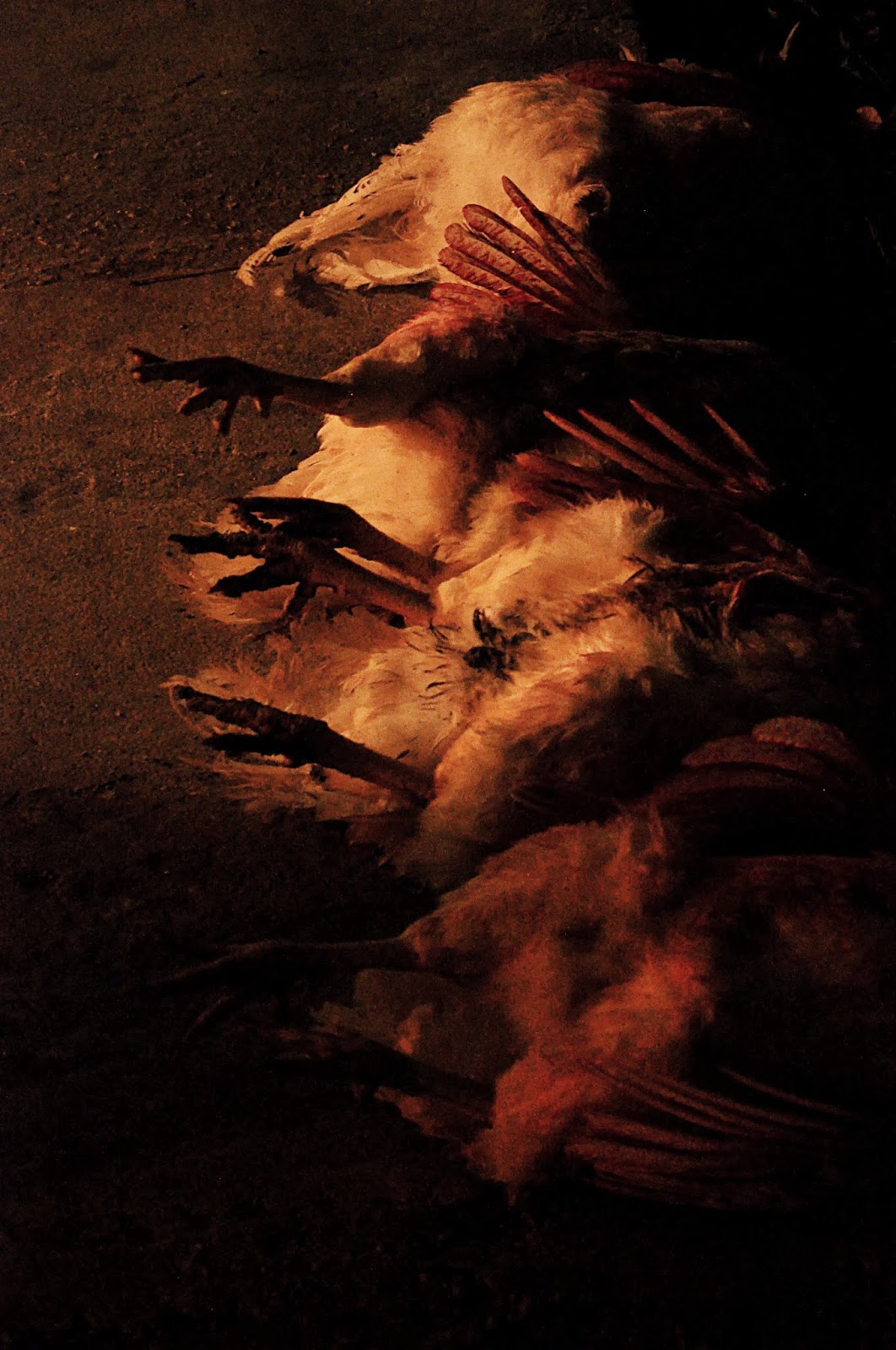
We make our way to the cemented land, to the edge. Laid down are the four lifeless fowls, side by side. Those toes stick straight out and the wings too as if they were broken. Deep red caress those once white feathers.
The flames blaze under the steal pot causing the water to roar. The smell, get ready. Oh yai, that smell. "It's something you can't forget." Nonc Ben picks the rooster up and raises it high. It hovers above the scalding water, down it goes. Fully submerged just for a second. Just as quick as it went in, it came right out. It hangs, dripping water. The water drips over the pot, over the pot, over the cement, over the trashcan. It hangs over the trashcan. Nonc kneels and my pop squats. They start plucking. Feather after feather, they fall into the can underneath. The rooster is neked, completely bare. Skins.
Done.
Next one.
Next one.
Next one.
Done.

Tuesday, December 17, 2013

Qui ce ça?

Monsieur Justin Léger
Photo credit: Madmoiselle Maggie Milke

Take the Scott exit, go until the first legitimate road to the left. Turn. The house with a line of cars parked in the front yard with the garage door open, you found it. Fiddle-plugged in. Accordion-plugged in. Guitar-plugged in. Bass-plugged in. Drums-miked. The jam lined the back wall. Plastic lawn chairs lined the other side, all filled with little white headed ladies and ole' grey haired men. In between stood a dance floor. Bare for only a moment. When a waltz was played, those little ole' ladies and those little ole' men got up and danced. Where I was, I was able to see the musicians, I was able to see the dancers. I was able to hear the music and I was able to hear the little ole' ladies and the little ole' men talk. They all talked in french, the old french. I listened carefully. It was amazing to think that all of these people have a history, all of them have a story. Some sort of story. Their ancestors survived and overcame this oppressive society. But all I could do was listen, I couldn't talk with them- I couldn't communicate. But my friends could, they did. Jamie Lynn and Jacques Boudreaux. The generational gap that was prevalent was bridged by the simple words of our cultural language. I grazed my eyes over the musicians again, my stare fixated on the fiddler. My eyes stayed on him, on that fingerboard, on that bow hold. The way he held it with his pinky finger under the screw and the rest gracefully placed on top of the stick. No tension, just comfort. He bowed with his forearm and wrist. Smooth-never a scratch. His left hand cradled the neck within the webbing beside his thumb. His left arm braced the body with a curved limb and an arched wrist. First, third, second, first. Back to third next string over, second, fourth. Chords. G to D. Grace it. C to G. He glances at the accordion player, he nods back. Fiddle ride. 
Qui ce ça?
Walter Mouton. 

 Now, Mr. Walter is legendary when it comes to dance hall music. Born in 1938 and responsible for putting together the first rendition of The Scott Playboys when he was 15, which included Rodney Miller, John Allen Guillot, and Leeman Prejean. In 1970 he and his band recorded "The Scott Playboys Special," his music is also heard on the sound track to the film J'ai êté au bal. The 1998 Festivals Acadiens et Créoles was dedicated in his honor. But his principle fame extends from his 35 year relationship with Breaux Bridge's La Poussière Club. Every Saturday he and his band performed. "I consider myself a dance band as (opposed) to an authentic Cajun band," Mouton told Dominck Cross for a 1998 article in the Baton Rouge Advocate.

After the fiddle ride, the accordion took it. As the bellows started to breathe heavier and louder, it pulled my attention away from the fiddle. The waves of the wailing notes grabbed my eyes. Right hand spread across the ten buttons. Left hand on the bass notes, the arm pushing and pulling. The accordion is the lung, it is the breath. The way is breathes. In, one pitch. Out, another. I always watch musicians and how they produce their art. Every one is different. Everyone has their own style, their own form. I make those observations and I notice those differences. When I look at the younger generations and their approach to the traditional music, many of which have those old tendencies, it is never completely lost. It is never completely gone. They know and understand the importance of preservation. Their culture, my culture, our culture and heritage. And to totally disregard the way of what once was would be disrespectful. We come from the people and the land of what once was. There is one younger gen in particular that has intrigued my mind. Mr. Justin Léger- a Church Point boy. I recorded him and his friends the other night, of which I posted. His lyrical tone, the way he articulates the traditional songs- the stories of our people. Watching him close his eyes while he sings. He feels. The pain and sorrow in the words. When he cries out, he hears. I hear. I feel, it penetrates my soul. It tears, my vermilion blood seeps out and melts my senses. It takes me back. Them damn prairie boys. It's there. The appreciation, the understanding. The knowledge of what once was, the history of his people's struggles. I want to know his story. 


À plus tard, 

Zoë Louise Huval